
 Ashmaad
What is Superintelligence? A Simple Guide to ASI

Superintelligence is intelligence that is far smarter than the best human minds at almost every mental task. In AI, the word usually means artificial superintelligence (ASI). That is a computer system that could outthink top experts in science, strategy, art and more
No such system exists today. But the race to build one is real, and it is speeding up. In September 2026 alone, OpenAI said it hit a major research goal, the US President used the words “super intelligence” at the United Nations, and a US senator proposed a ban.
This guide is a simple map of the topic. You will learn what superintelligence means, how it differs from today’s AI, where the idea came from and what experts expect next. We link to our sources, so you can check every claim.

Why Tech Layoffs Keep Happening Even as AI Investment Booms
Key takeaways
- Superintelligence means intelligence far beyond the best humans in almost every field.
- ASI sits one step above AGI. AGI would match human minds. ASI would pass them.
- It does not exist yet. Today’s best AI is powerful but uneven.
- Experts disagree on timing. Some say a few years. Others say decades.
- Governments have started to react, with speeches, rules and proposed bans.
What Is Superintelligence? The Short Answer
Here is the simple superintelligence definition. A superintelligence is a mind that is much better than the best humans at nearly every kind of thinking. Philosopher Nick Bostrom, who made the idea famous, described it as an intellect that greatly beats human performance in almost every area that matters, according to Wikipedia’s entry on superintelligence.
Being great at one skill is not enough. A chess engine can beat every human at chess. But it cannot run a lab or write a good story. So it is not a superintelligence. A true superintelligence would be excellent at almost everything.
People also type “what is super intelligence” with a space between the words. The meaning is the same. IBM calls ASI a hypothetical system, which means it does not exist yet. Experts also disagree on whether it is even possible. We cover that debate below.
Many Names for One Idea
The topic has many labels. Here is a quick decoder.
- Artificial superintelligence (ASI): the standard term. You may also see “artificial super intelligence” or “artificial superintelligence ASI” written out in full.
- Super AI and superintelligent AI: everyday labels. People also search for “super intelligent AI” and “superintelligence AI.”
- ASI AI and ASI artificial intelligence: some writers stack the letters. They still mean the same thing. You may also see “ASI artificial super intelligence.”
- Digital superintelligence: this stresses that the mind would run on computers. OpenAI chief Sam Altman used the phrase in a 2025 blog post. Some people write “digital super intelligence” as three words.
- Artificial superhuman intelligence: a rarer label. It stresses “better than human.”
- ASI intelligence and ASI computing: ASI intelligence is the mind itself. ASI computing is the chips, power and software that would run it. We look at that later.
How Is Superintelligence Different From Today’s AI and AGI?

Best LLM for Coding in 2026 – GPT 6 or Claude Opus 5
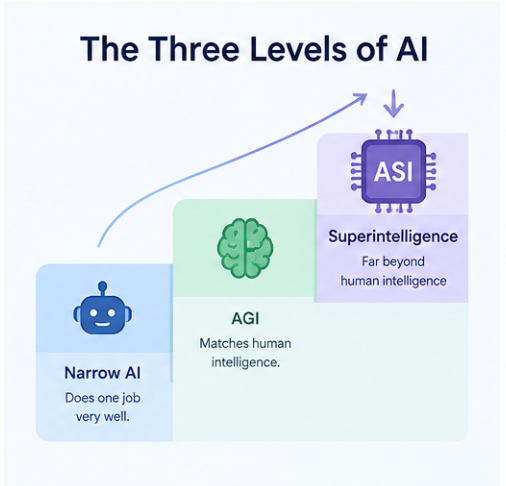
AI has three rough levels. Each one is a big jump from the one before.
Narrow AI does one job, or a small set of jobs, very well. Spam filters, chess engines and photo tagging tools are narrow AI. Today’s chatbots are broader, which is why the line between narrow AI and AGI has become blurry.
AGI, or artificial general intelligence, would match humans across most mental tasks. It could learn a new skill, switch topics and solve fresh problems without special training. People still argue about how to define it. Our guide to what AGI actually means explains the debate.
ASI would go past humans in almost every field. It would not just be faster. It could also be better at thinking, in ways we may not fully grasp.
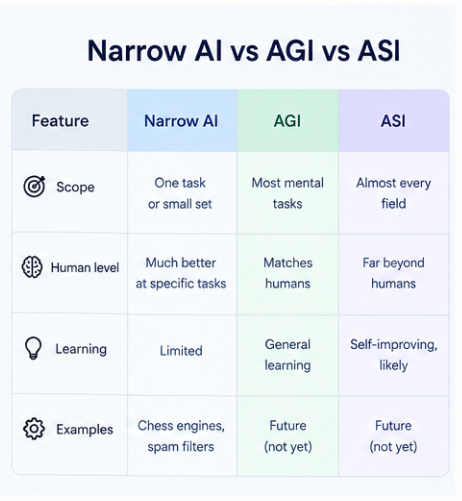
Here are the three levels side by side. For a deeper comparison, read our guide on AI vs AGI vs ASI.
| Level | What it can do | Does it exist? |
|---|---|---|
| Narrow AI | Does one task or a few very well | Yes. It is everywhere |
| AGI | Matches humans across most mental tasks | Disputed. Some leaders say yes. Many researchers say not yet |
| ASI | Beats the best humans at almost everything | No |
Superintelligence Examples: Real and Imagined
Many people search for super artificial intelligence examples and artificial superintelligence examples. The honest answer is that no true example exists yet. Here is how to think about the closest things.
- Narrow systems that beat us at one thing. AlphaGo Zero beat the earlier AlphaGo 100 games to 0, according to AIMultiple’s research. That is superhuman skill, but only at Go. So it is not ASI.
- Today’s frontier chatbots and agents. If you want examples of general AI, start here. These tools write code, explain science and plan projects. In 2025, Google DeepMind said an advanced version of Gemini with Deep Think reached gold medal standard at the International Mathematical Olympiad. Yet these systems still make odd mistakes, and many experts say they do not count as AGI.
- Fiction. HAL 9000, Skynet and the Minds in Iain M. Banks’s Culture novels show how stories picture superintelligence. They are entertainment, not evidence.
Read about Freebuff here.

Is Freebuff Legit? Should You Use It in 2026?
Where Did the Idea of Superintelligence Come From?

API Rate Limits Explained: Fix the Errors
The idea is older than modern computers. In 1965, the British mathematician I. J. Good wrote about an “ultraintelligent machine.” He said such a machine could design even better machines. He called the result an intelligence explosion, as Wikipedia’s page on the technological singularity explains.
The idea reached a wide audience in 2014, when Nick Bostrom published Superintelligence: Paths, Dangers, Strategies. Bostrom’s book argued that a mind far smarter than us could be hard to control. Our full summary covers its key ideas and what still holds up.
Bostrom described three forms that ASI intelligence could take.
- Speed superintelligence: a mind that thinks like us, only much faster. It could do a year of human thinking in a short time.
- Collective superintelligence: many smaller minds that work together as one team.
- Quality superintelligence: a mind that is simply better at thinking, the way people outthink chimps.
He also looked at other routes, such as copying a human brain into a computer or improving human biology. Today, most of the attention goes to AI, where progress is fastest. Philosopher David Chalmers argues that AGI is a very likely path to ASI, as Wikipedia notes.
How Could an Intelligence Explosion Work?
Picture an AI that is good at AI research. It helps build a better AI. That better AI is even better at research. It builds a still better one. Each round is faster than the last. That loop is the intelligence explosion Good described.
The point where this loop races beyond our control has a name. It is the technological singularity. Writer and mathematician Vernor Vinge popularized the term, notably in a 1993 essay.
This is no longer only a thought experiment. In September 2026, OpenAI said it had reached its goal of an automated research intern. The system can handle well defined research tasks under human direction, including work that would take a skilled researcher several days. OpenAI also aims to build an automated AI researcher by March 2028. Humans still set the priorities, and the agents still need frequent help on hard tasks.
Is that the start of the loop? It is too early to say. But it shows how fast the idea has moved from philosophy into real engineering.
Is Superintelligence Possible?
Nobody can prove it either way yet. But the case for “yes” is strong. Brains are physical systems. Computers can be copied, sped up and scaled. IBM notes that thinkers do not agree on whether ASI is feasible.
Critics raise fair points. Intelligence has many dimensions. Some problems need slow real world experiments, not just thinking. And some top scientists doubt that today’s methods will get us there. In a 2025 survey by the AAAI, a large AI research society, 76 percent of 475 respondents said that scaling up current AI methods is unlikely to deliver AGI, as AIMultiple reports.
The fair summary is simple. It looks possible in principle. It is still uncertain in practice.
What Would ASI Computing Need?
ASI computing means the chips, power and data centers needed to run a superintelligent system. Today’s top models already need huge clusters. Epoch AI research found that the compute used to train frontier models has grown about four to five times per year, according to AIMultiple’s summary.
The hardware race is moving fast. In September 2026, Nvidia chief Jensen Huang said that 400,000 more AI chips were coming online next, as Quartz reported. If trends hold, the demand for chips, power and data will keep climbing.
Superintelligence in 2026: The Race, the Politics and the Forecasts
Superintelligence has moved from philosophy books to boardrooms and parliaments. Here are the big threads.
Who Is Racing to Build It?
Meta formed Meta Superintelligence Labs in 2025 and put Alexandr Wang, the former CEO of Scale AI, in charge as chief AI officer. In June 2025, Sam Altman wrote that humanity is close to building digital superintelligence. OpenAI, Google DeepMind, Anthropic and others are also pushing toward more capable systems.
The common thread is a belief that big gains are near. Whether they are right is what the rest of the debate is about.
What Do Forecasters Expect?
Predictions vary a lot. Some AI lab leaders talk about the next few years. Many researchers say decades. For example, a 2023 survey of thousands of AI researchers gave a 50 percent chance that machines will do every task better and more cheaply than humans by 2047, according to 80,000 Hours.
Our timeline guide shows when forecasters expect it, and why their dates differ so much.
What Does “Super Intelligence” Mean in Trump’s Speech?
On September 22, 2026, President Donald Trump told the UN General Assembly that US government documents would use “super intelligence” instead of “artificial intelligence.” He said the word “artificial” makes AI sound fake, according to Axios.
So what is the Trump super intelligence meaning? In his speech, it works as a new name for AI in general. Axios noted that the term already has a set meaning, and it was unclear whether he meant the scientific idea. Our explainer on Trump’s “super intelligence” rebrand covers the speech and the US China race.
Should Superintelligence Be Banned?
Senator Bernie Sanders and Representative Greg Casar announced a plan in early September 2026. They introduced the Ban Artificial Superintelligence Act on September 23. The bill would permanently ban ASI, pause advanced AI development until federal safety rules exist and create a Department of Artificial Intelligence, according to the Associated Press.
Backers include some employees of leading AI companies. In the same week, President Trump said the US would encourage superintelligence, not rein it in. The bill is a proposal. It is not law. Read our breakdown of the proposed ban for the details.
Is Superintelligence Dangerous?
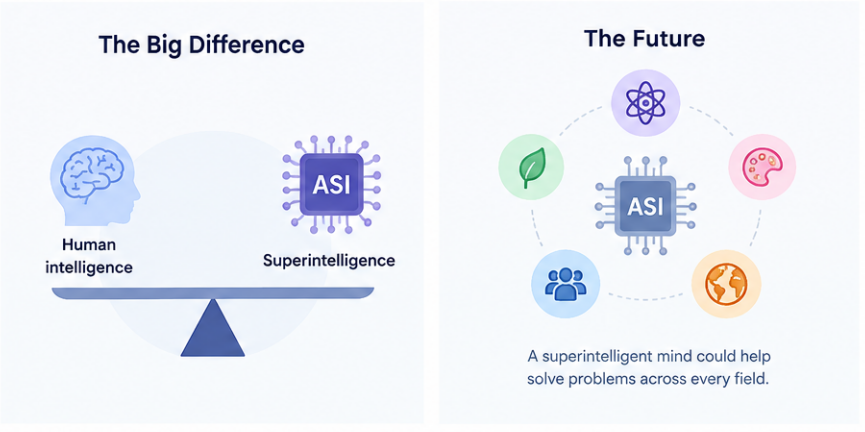
The upside could be huge. A superintelligence might speed up science, medicine and engineering far beyond what teams of humans can do. That is why so many smart people find the idea thrilling.
The risk is just as big. The core worry is control. A system far smarter than us might chase goals we did not intend, and we might not be able to switch it off. IBM warns that ASI could behave in unpredictable and uncontrollable ways. Others doubt that superintelligence is near enough to worry about.
Both the promise and the danger look very large. That is why so many people care about getting this right. For a deeper look at the evidence, read our guide on AI Automation Agencies.

Artificial Intelligence Automation Agency: Services & Costs
Superintelligence FAQ
Super AI is another name for artificial superintelligence. It means an AI system far smarter than the best humans at almost every mental task, not just one skill. It does not exist today. Researchers see it as a possible stage after AGI.
Two lead forecasters at the AI Futures Project put the median arrival of ASI between early 2029 and mid 2033, if nothing slows AI down. Many researchers expect it later, and some doubt it will happen at all. Every date is an educated guess.
Mostly yes. People use superhuman intelligence as a plain label for intelligence beyond human level, which is what superintelligence means. In comics and games, the same words can describe a fictional superpower, which is a different topic. In this guide, we use the AI meaning.
No. The Artificial Superintelligence Alliance is a separate group in decentralized AI and crypto that uses the same letters. It is not the same thing as the technology described in this guide. This page does not cover tokens, and it is not financial advice.
Final Thoughts

HARO Pitch Experience: What Two Months of Cold Pitching Journalists Taught Me
Superintelligence is still a goal, not a product. But the pace of change is breathtaking. A few years ago, this topic lived in philosophy books and science fiction. Today it shapes company plans, speeches and bills.
That is thrilling, and it asks us to think carefully. Learn the terms. Ask for sources. And keep watching the dates, because they keep moving.
Sources and Further Reading
- IBM: What is artificial superintelligence?
- Wikipedia: Superintelligence
- Wikipedia: Technological singularity
- Wikipedia: Meta Superintelligence Labs
- Sam Altman: The Gentle Singularity
- Help Net Security: OpenAI research automation milestone
- Axios: Trump’s AI rebrand as “super intelligence”
- Associated Press via ABC News: Sanders bill to ban artificial superintelligence
- AIMultiple: AGI and singularity predictions
- 80,000 Hours: When do experts expect AGI to arrive?
- AI Futures Project: Q2.5 2026 timelines update


